
the Human Connection Moat
For thirty years, the “build versus buy” debate was the persistent game of tetherball in the CTO’s office. It was a rational, if often heated, accounting exercise. On one side: the allure of ultimate control—software tailored perfectly to your unique business logic, free from the constraints of a vendor’s roadmap. On the other: the pragmatic realization that recreating wheels is a waste of talent. We bought SaaS because we wanted to offload the “undifferentiated heavy lifting.”
We weighed compute, storage, and networking against the total cost of ownership (TCO). We calculated the “maintenance tax”—the reality that you are responsible for the security, stability, and updates of that application for its entire natural life.
Then came Generative AI, and the math didn’t just change—it broke.
Today, we are witnessing the “SaaSpocalypse.” AI has significantly increased the speed at which developers can produce code, effectively tricking us into believing that the cost of building has plummeted to near zero. A VP of Engineering looks at a $200k/year SaaS bill for a feature flagging service or an observability tool and thinks, “My lead dev could prompt a replacement for that in a weekend.”
But that thought is a trap. It is a fundamental misunderstanding of what we are actually paying for when we “buy,” and a dangerous undervaluation of what it takes to actually operate software at scale.
The Deployment Delusion: Why AI Speeds Up Shipping but Not Value
In the world of Progressive Delivery, we have a foundational mantra: Deployment is not Release. AI is a world-class “deployer.” It can spit out a feature flagging service or a messaging app in seconds. But as I’ve argued before, moving bits to a server is the easy part. The hard part is the release—the controlled, observed, and staged rollout of functionality to users in a way that doesn’t break the business.
When you use AI to “build” a replacement for a specialized SaaS, you are optimizing for the “typing” phase of software development. But as Fred Brooks famously noted in The Mytdhical Man-Month, there is no “Silver Bullet.” AI addresses the accidental complexity (the syntax, the boilerplate, the CRUD operations), but it is powerless against essential complexity (the intricate, messy business logic and the high-stakes coordination required to keep a system running, and compliant).
AI-built software often lacks the “guardrails” that come standard in a mature SaaS. It doesn’t know how to handle a “thundering herd” problem. It doesn’t understand the nuance of cross-region latency. It simply does what it was prompted to do. You might have saved $200k on the subscription, but you’ve just inherited a million-dollar liability in “Day 2” operational risk. And this does not even consider what this does to your security and compliance posture.
The Cognitive Toil : “Day 2” is Where SaaS Wins
What about the ongoing maintenance? If AI builds the system, it will pull open-source packages and services. You will need to regularly check the code for security, patch it, and ensure third-party integrations are maintained.
One of the most important frameworks for modern technical leaders is Team Topologies by Matthew Skelton and Manuel Pais. They argue that the most successful organizations are those that minimize the cognitive load on their “Stream-aligned” (product) teams.
When a product team is forced to build and maintain their own infrastructure tools because “AI made it easy to write,” their cognitive toil explodes. They are no longer focused on delivering customer value; they are focused on patching their internal billing system or managing the security updates for their DIY observability stack.
This is cognitive toil; or the “Day 2” trap.
- Day 1: You prompt the AI, the code is generated, the tests pass, and everyone celebrates the “savings” as you successfully deploy to production.
- Day 2: The API you’re hitting changes. A security vulnerability is found in an underlying library. The database starts locking up under a new load pattern.
SaaS vendors exist to solve Day 2. They are “Platform Teams” as a service. By paying that subscription, you are ensuring that your team stays focused on your mission, not on the plumbing. If your “AI-built” tool requires one-quarter of an engineer’s time to maintain, you haven’t saved money—you’ve just hidden the cost in your payroll.
Plummeting value of “Code”
If we sort out the quality and completeness aspects of AI code creation, the cost of creating new software plummets, and I can build a feature myself faster and cheaper. The value we get from a SaaS service is diminished from a purely feature-functionality perspective.
If the SaaSpocalypse comes and the value of any particular feature is reduced, what new value does a SaaS company bring to the table?
In this possible future, the shifting value will move from feature functionality of the product to the community that surrounds it. We’ve seen this movie before. OSS projects are only as successful as the community that supports them. For the non-OSS software company this represents a drastic shift in how you deliver value to the customer. Features still matter, after all you still need to be able to use the software to complete the task at hand, but the moat—what makes you stand out from all the other vendors and competition—shifts to your people, and the experience they provide. Your people—and not your technology—are the feature your customers value.
Your developers still need to build (most likely using AI) to continue to optimize and expand the value you create for your customers. But in this brave new world that is no longer a defensible moat you can rely on. Increasingly, customers will look for how you respond to their feedback and support of their use and success with your products.
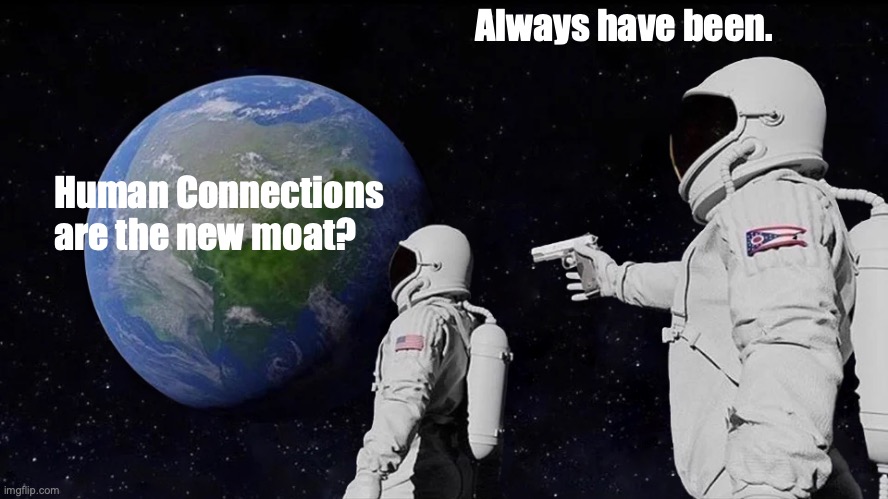
Human Connections are the New Moat
A universal feeling these days, for anyone who is not living under a rock, is the increase in frustration when you encounter a corner case. FAQs and chat bots are great when the problems you’re facing are common and anticipated. But what if your problem is not in the FAQ or covered by the docs? Welcome to the evil hellscape that AI has wrought upon the customer service industry.
We all thought pre-recoded phone trees were bad in the 90’s, then AI chat bots showed up and just said, “hold my beer.” Large companies have been quick to use this slick technological wizardly to increase margins and reduce customer service staff, leading to short-term gains at the the cost of diminished customer good will.
There are some companies that have navigated this well. They have kept human representatives available and made it easy to “escape out” of the standard chatbot or phone tree automation and mainstream troubleshooting to quickly reach someone who can solve a detailed, in-depth problem that the product didn’t account for.
So, what is the new moat? It’s Human Connections.
In her book Working in Public, Nadia Asparouhova discusses how the value of software is shifting toward the people who maintain it. This is even more true in the SaaS world. The real value of a vendor is the human feedback loop after the initial application is deployed to production.
Anyone who has ever built a product knows that the way you intended a technology to be used is rarely the way the customer actually uses it. Users are creative, messy, and unpredictable. They often operate in what I call the “Creative User Context.”
Here is a recent thread with some examples of creative context from last week:
This is where AI fails. AI is built on the training data of the past—on the definitions we have already put into the system. It cannot foresee the unexpected ways a creative or frustrated user will break your system. It cannot “think through” a corner case that hasn’t happened yet.
The companies that will survive the SaaSpocalypse are those that realize Customer Success is the new Use Case. The value isn’t the feature; it’s the person you can call who can contextualize your specific “creative context”. It’s the feedback loop that helps you understand adoption patterns rather than just click-through rates.
This is going to be the new model in the future. We will see the rapid adoption of AI and automation technologies in products and services. But the companies that will rise above and continue to be sought after—the ones we are willing to pay for—will be those that actually have the ability to deliver the right value, to the right users, at the right time.
Conclusion: Knowing What “Good” Looks Like
The “build vs. buy” math has changed, but not in the way the AI evangelists want you to think. AI has made it easier than ever to build something, but it has made it harder than ever to build the right thing and keep it running.
As technical leaders, we need to stop being seduced by the speed of the “Day 1” prompt and start obsessing over the “Day 2” reality.
The moat is no longer the code. The moat is the human capacity to navigate the unexpected. It’s the expert knowledge of what “good” looks like. This is achieved through experience, critical thinking, and the feedback loops that turn a tool into a solution.
Before you decide to “AI-away” your SaaS bill, ask yourself:
Who is going to answer the phone when the “creative context” hits? Who is going to manage the cognitive toil of maintenance?
Who is going to ensure that your deployment doesn’t just move bits, but actually delivers value?
If the answer isn’t a dedicated, specialized team with a proven track record, then you aren’t saving money. You’re just buying a ticket to a very expensive disaster.
In the age of AI, the most valuable “feature” you can buy is the empathy of a human who has the ability and desire to help when the AI gets it wrong. Choose your dependencies wisely.
 Progressive Delivery
One response to “AI kicked my SaaS”
[…] 详情参考 […]